Based on the BREED STANDARDS I considered and eliminated several different breeds.
I was looking for a non-shedding structurally sound square working dog
I also had to have a short tail that would not whip around
(having had a visiting lab's tail knock over my lit candles and drinks)
I have seen my friend slam the door on her American Bulldog's Tail causing great injury.
I have seen another friend's doberman hit the wall so much with wagging
that it was always injured and bleeding.
ANWAY...there are options for a short tailed breed and I choose the
Standard Poodle breed based on the breed's standard for my
desires to do safe pet therapy (not knocking over people and kids
and also not to get caught in wheel chairs).
I also wanted a warm, loving, empathetic, happy sweet nature.
I found when reading the BREED STANDARD that the breed
that most suited my lifestyle was a Standard Poodle.
Humans refined various breeds to fit into their lifestyles to fill
a human need such as hunting or protection or companionship
and for HUNDREDS of years the Standard Poodle was "refined" to suit the needs of Human Kind.
1642 Standard Poodle with a docked tail
Standard Poodles have had their tails docked to fufil their purpose of therapy dog,
companion, protector and retriever since 1642
as seen in Prince Rupert of the Rhine's Poodle "Boyu"
which is said to be the earliest illustration of the Standard Poodle with docked tail
To all of sudden in 2023, HUNDREDS OF years later,
to say that the Poodle is lost, without their tails seems a ludicrous to say the least.
So why are some Breeders not doing it or Fighting agains the Anti docking ?
MONEY and LACK OF SKILL AND KNOWLEDGE and not wishing to FIGHT THE AR PEOPLE.
Or are People that breed and lack the skill and knowledge
and have no intentions of learning how to be better for their Poodles.
They often purchased from a BYB and never mentored under an experienced
breeder to learn the ins and outs of proper breeding, which includes docking and dewclaw removal.
Then there is the Novice Breeder, who has the knowledge, but will still go to the Veterinarian
and has just decided that they don't want the added expense.
Once breeders and owners have had a long tail, most will ask for a docked tail the second time around
after experiencing the many hazards I mention above.
If you decide to have a Poodle with an undocked tail and dewclaws remaining, PLEASE make sure you look
after your Poodle's wellbeing and get those dewclaws trimmed every 1-2 weeks.
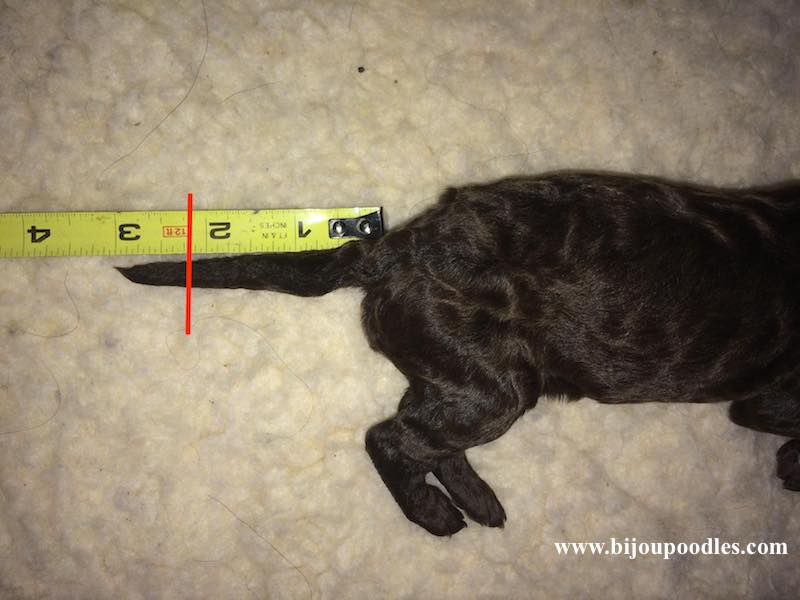
... (tail docked and tail as it would appear if it were left long)
Tail Docking:
Bijou Poodles dock tails when the puppy is born as this results in minimum discomfort
because the tailbone is still soft and the nervous system that relays pain signals is undeveloped.
Docking causes no more discomfort than ear piercing on humans, and is over in seconds
Some puppies are docked while they are asleep and do not even wake up.
After docking, puppies will immediately feed and snuggle with mom.
(using a white legged dog to show clearly the dewclaw)
Dewclaw Removal:
The Dew Claw is in the evolutionary process of disappearing.
Dew claws are like thumbs and unlike digits 2, 3, 4 and 5, are not used for walking and do not natural wear down.
Dewclaw removal is also done same day puppy is born, and is just plucked off.
Real Breeders will do this procedure themselves, for the safety of their precious puppies
not being exposed to all the illnesses at the Veterinary Clinic and to also ensure it is done properly.
Bijou Standard Poodles removes our dewclaws to prevent future serious injury based on our experience.
We have had our poodles dew claws injured at groomers who didn't expect a dewclaw to be there
and almost amputated it when clipping.
We have had our Poodle's themselves almost pull their dewclaws off when caught in carpet while running.
We have heard, "Dogs need dewclaws to help with 'cornering' while running". I'm hear to tell you
if our Poodles had dew claws, we would be treating torn dew claws every weekend we did FAST CAT or Coursing.
We have also seen dewclaws gotten forgotten for months, by owners and not been clipped.
Dewclaws will wrap around itself and imbed into the leg causing great discomfort
and needing a great deal of care to clip if not surgery.
Dewclaws do not get worn down on their own like other nails as they do not touch the ground.
An injured dewclaw has a major amount of blood loss and excruciating pain to the Poodle.
Such a simple procedure for us to remove the dewclaws, to ensure our pups
have an injury free future and do not suffer from unclipped nails that dig into their pads
or being injured at the groomers. Just Common Sense.
Taking on the Taboos: Learn the Inside Story of Veterinary Procedures
Dr. Marty Greer, DVM and host Laura Reeves take on the recently taboo subjects
of veterinary procedures such as bark softening, tail docking, ear cropping and dewclaw removal.
Greer covers the how, when and, importantly, WHY of these procedures. Dewclaws
I don’t see problems with the dewclaws coming off.
I know there are people who feel that it weakens the carpal joint in the dog and I, to this day,
have not seen a dog breakdown it’s Carpus and have difficulty with its carpal joint related to a declaw removal.
We do see dewclaws that get torn off during hunting, during other kind of activities.
I actually haven’t seen any literature that suggests that they’ve got proof that (dewclaw removal) makes a difference.
Tail Dock
Nothing, nothing is more horrible than a broken, bleeding tail. Nothing.
They crack them on the wall in the crate, in the kennel. And then they start to bleed.
And then, oh my God, it looks like an axe murder happened in your house.
It is unbelievable how much blood they can spray around from the end of their tail,
and they’re very hard to bandage. They don’t heal very well, so they can be a real challenge.
There’s a lot of reasons that people do tails. It’s not just about breed type, it is really about function as well. Ear Crop
Breed type is a big deal. If you don’t crop the ears on a Doberman, it doesn’t look like a Doberman.
I think we have to be really honest with ourselves that it’s about appearance, it’s about breed type.
It’s primarily a cosmetic procedure and we have to be honest about it.
But you have to decide what you’re breeding for because again, ear set and ear leather
has changed because people don’t really pay attention to it.
Debark
Some people call it urban bark. Some people call it bark softening.
It kind of gentrifies the term a little bit because you’re really not taking away the bark.
You really are softening it. And there’s a lot of misconceptions about it.
I’ve heard all kinds of stories about how cruel it is and how difficult the procedure is for the patient.
And honestly, none of them are true.
In Closing
I will tell you that a lot of the procedures that (some folks) are telling people
not to do, are far less invasive and far more beneficial for the pet than band aiding their Pet after injury
or that cause people to return or re-home their pets for.

 ...
...

