BIJOU STANDARD POODLES
!! AVAILABLE PUPPIES !!
Meet Our Poodles... Our References... Web Page Links
Questions Answered... Whats New at Bijou...Bijou Difference
Contact us: brownpoodles@yahoo.com

Pediatric Spay/Neuter
7 weeks or 16-20 weeks ... is it really that beneficial to wait an additional 9 weeks ?Anyone with common sense knows the answer is "no".
The ONLY reason Vets prefer to wait until a puppy is older, is because it is easier for them to do the surgery
as the reproductive organs will be easier to see and get to and NOT for the health or benefit of the puppy at all, just ask them.
This proceedure has been done for over 30 years according to The American Veterinary Medical Association.
Bijou Standard Poodles has been doing this procedure, with following up on our pups since 2003.
As you can see our "altered" Poodles our physically strong, beautiful and long lived Click here to view
All of the pet Poodles you see featured throughout our web page were spayed or neutered at 7 weeks of age
and as you can see, they have grown into some stunning looking, healthy adult Poodles
Our Poodles
So why don't all breeders offer this or bash responsible breeders, doing this ?
The answer is simple and unfortunate, "MONEY"
Irresponsible breeders, do not want to be paying for something that they feel they don't have to,
in order to to sell pups. Paying for this, they feel is money out of their pocket, not concerned about their pups future.
This is not cheap for breeders to pay for. For us to do a litter can cost up to $3,000.00 done by a surgical expert.
So why does Bijou Poodles want to pay for, and do this procedure ?
Because we believe it is our Pup's best interest to be done by our trusted expert of over 45 years
We care about our pup's future and our puppy people and wish to do this procedure
when there is minimal chance of greater injury or long term problems.
And because our Pup's best interest comes first.
Bijou Poodles charges the same price for our superior bred pups as BYB's do,
and we also save our Puppy people up to $1,00.00 by paying for a spay/neuter procedure.
~ Make sure to factor this cost savings when you search around and price up, other breeder's pups ~
We do not go into this blindly. We have studied and evaluated other breeder's doing this procedure for years
as well as evaluating various Veterinarian's surgical aptitude, and spending years of reading research on the subject.
As a result of our knowledge and experience, we have found a number of Vets that specialize in this procedure
and perform it routinely for responsible breeders. We have seen 3 lbs kittens and 6 lbs puppies
run around 1 hour after their spay and or neuter and we have also documented our own pups showing
no apparent discomfort 1 day, next day and up to a week following surgery and over 10 years later all in excellent health.
View our documented video on our puppy follow ups below, to see what we mean.

(Photo curtesy of Perfectworld Poodles)
Lets face it. No owner or dog would want to go through this experience.
The guilt involved when you look at your Poodle and consider taking them into the Vet
The cost of up to $1,000.00 involved in getting surgery done later in life
(Just call various Vets and price up spay/neuter of a 45lbs dog with pre-op blood work and vet visit $)
The time off of work to take your Poodle into the Vet and pick the Poodle back up the next day
The risk involved in taking your Poodle to the Vet and hoping they have the experience
needed to have a successful surgery and recovery (which we have discovered is slim, to none)
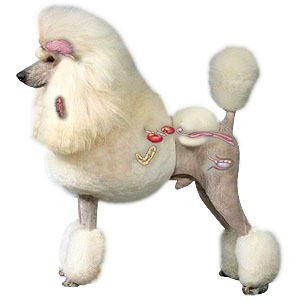
WHAT ABOUT THE HORMONES ??
Bijou Poodles offers our puppy people an alternativeto the Spay or Neuter procedure, called Tubal ligation or Vasectomy .
Tubal and Vasectomy are the same minor procedure as humans
get done to prevent unwanted pregnancy, still leaving the reproductive organs in place and hormones functioning normally.
The benefit to some people of choosing a Tubal or Vasectomy procedure, is that the puppy will have ALL their hormones
and growth happening normally, because hormone production and development is still occurring.
This means that male dogs will still have testicles (same as human men that have the proceedure)
and females will still retain their uterus and uterine horns (same as human women that have had their tubes tied).
The choice is yours if you wish your puppy to have a spay (hysterectomy)
or neuter (castration) or a Tubal or Vasectomy.
The downside to Vasectomy choice, is that males will still have sexual urges driven by hormone production.
Also as with intact dogs, there is a chance that the testicles although descended at time of surgery
will be sucked up and not drop down properly in place. Later on in life this is an expensive castration to have done.
The downside to a Tubal is that and females will also experience mood changes and going through a heat cycle (bleeding for 10 days)
every 4 to 6 months, as well as still attracting males who will all wish to breed her.
The female may even go through a false pregnancy in rare cases.
The choice of Vasectomy or Tubal Ligation procedures ensures the puppy is unable to reproduce,
but gives new owners the option of when, or even if, they will have a spay or neuter done later, and at their discretion.
We are able to offer this procedure option for an additional $100.00.
During a spay or neuter the reproductive organs are removed. The male will not have testicles
and the female will no longer experience heat cycles (bleeding) every 6 months of age.
Castration or Hysterectomy commonly referred to as a Spay or Neuter,
is the usual proceedure that most Vets will be very familiar with and have been doing since early 1900's.
OF COURES PROOF IS IN THE PUDDING
SO CHECK OUT OUR ALTERED ADULTS BELOW
 ...
... 
Fin at 1 year of age .................. Finnegan at 3 years of age
Both of these boys are UKC Alter Champions with Multi Best in Show "Finnegan" being the first Red in History
Both these Red Males were pediactric neuters at 7 weeks of age
 ...
...
Muti Best in show "Reigna".............. Maeby
Both of these Brown Females had pediatric spays at 7 weeks of age
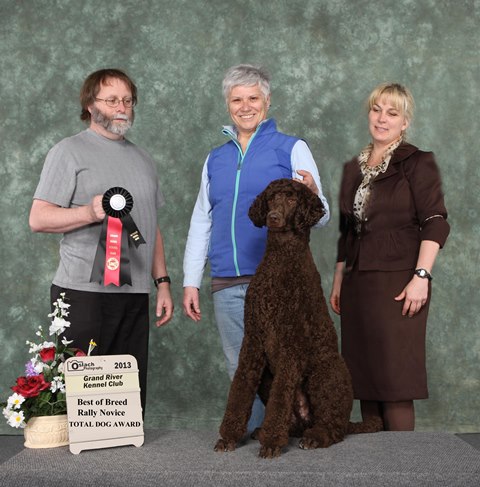
(Bodhi pictured at 14 months of age, who was neutered at 6 weeks of age)
Rally Judges: Paul Oslach, Paul Oslach, Heidi Kadoke
Conformation Judge: Joseph Gubry
Bodhi qualified and completed his Rally Novice Title with 1st Place Class placements
and also Won an Alter Best of Breed for 2 competition wins and 50 Points towards his championship
and because Bodhi did both Rally and conformation the same day he also won a
coveted TOTAL DOG AWARD !!!
Way to go Carol and Bodhi

(Beau - brown male neutered at 6 weeks of age)
Best in Show, Champion, "K Lar's Brilliant Beaujolais ", URO1, URO2, CGN
~ 5x TOTAL DOG AWARD ~
Height: 26.5"
Weight: 65 lbs
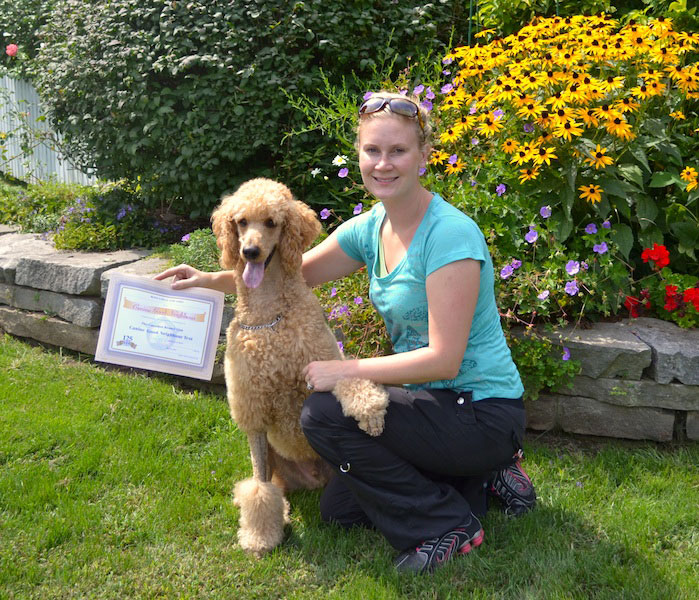
Champion, "Bijou's Aero", URO1, URO2, CGN
~ 2x Total Dog Award ~
Height: 28"
Weight 63 lbs

People worry that this early procedure might stunt growth.
In fact, research shows that the dogs will actually get slightly Taller and
we used to say leaner, but we found out this was in part to owners actually restricting their diets.
When the pups are toilet trained we really encourage people to leave food down 24/7 for their Poodles.
~ Every Poodle displayed through our web page not owned by us, has had pediatric spay/neuter ~

Bone Density
The reason for slight growth increase on altered dogs apposed to intact dogs,is because the long bones tend to grow for a slightly longer period.
Since this extra growth is NOT caused by more rapid growth,
but instead by prolonged growth, the implication is that this might be a good thing in our breed.
It is known that when growth proceeds slowly over a longer period
the bone density (strength) increases.
This means altered dogs should have stronger more dense bones

People also worry about puppy having Urinary incontinence after the procedure.
Our pups will have 2-3 days that they pee a LOT. Basically "frequency" but after this short period they
are in control and no mistakes. In a rare case we have had pups experience a Urinary Tract Infection
but we are unsure if this is related to the surgery or because people are restricting water to aid in toilet training.
Puppy needs water at all times except at night while in their crate/cage.

(Finnegan, Reigna, Finn)
*Click to read about what you can do with your Bijou Poodle
UKC Video about showing in Alter Class
UKC's Announcement about new Alter Classes
Early Spay/Neuter is commonly referred to as Pediatric Spay/Neuter
What ever your Decision is, we offer this proceedure through our Veterinarian,
with us assuming all risks and costs involved. As you know this procedure
could cost you between $200.00-$1,000.00 at a later date, so having us do it would be a huge
cost savings to you. Why we would offer Pediatric Spay/Neuter at an additional expense for us?
Because we feel after our research that our pups would be healthier and recovery quicker, less chance
of long term injury from a less experienced surgeon, use of minimal anesthetic, have less scarring, less loss of self,
quicker recovery, less stress and financial strain on owners and overall with less trauma for the puppy.
 ....
....
Neuter Incision 1 hour after surgery .......................................... Spay Incision 1 hour after surgery
Puppies 1 hour after spay and neuter Surgery
Puppies 1 hour after spay and neuter Surgery
Puppies 1 hour after spay and neuter surgery
Puppies 1 day after surgery
Pups 1 day after surgery
Puppies 1 day after surgery
Puppies 2 days after surgery
Puppies 7 days after Spay
Puppies 7 days after a neuter

Bijou Poodles has been offering this proceedure for since 2004 and we have kept in contact with several of our Puppy People
all of which have healthy adult Poodles winning in Performance Events and Best in Shows, which are featured on our web page.
However, all our pups are from healthy, health tested, great tempered adults that have excellent conformation.
A puppy's hormones are no more physically done working by 16 or 24 weeks, any more than they are at 7 weeks.
so waiting an additional few weeks to spay or neuter just does not make any sense.
Bijou Poodles as a result of our Study and consultation with many Vets, feel that Spaying and Neutering
is a desirable thing to do and offer this procedure to our puppy people, with Bijou Poodles assuming all costs
all risk and all responsibility for, and during the proceedure.
 ....
..
....
.. 
(Puppy wet after a bath and just had visible sutures removed @ 7 days)
On occasion a female puppy may have a reaction to the internal sutures.
This is when the incision site has a hard marble like swelling that will diminish and resolve without any treatment.
We have only had a couple pups have a swelling get bigger to a golf ball size and in that instance the puppy went on antibiotics
to clear up the swelling with no further complications.
Urinary Tract Infection (UTI)
On occasion our pups have developed a UTI
in which the puppy has had the need to pee small amounts frequently.
Owners can become very frustrated as they take the puppy outside to potty a lot
and yet when puppy comes back inside, puppy still pees inside the house.
UTI's can be caused by Owners restricting water access in attempts to toilet training.
Never restrict water access except when puppy is in the crate for the night.
Urinary tract infection, which can be positively diagnosed with a simple urine sample,
is easily cured with proper diagnosis and a course of antibiotics.
